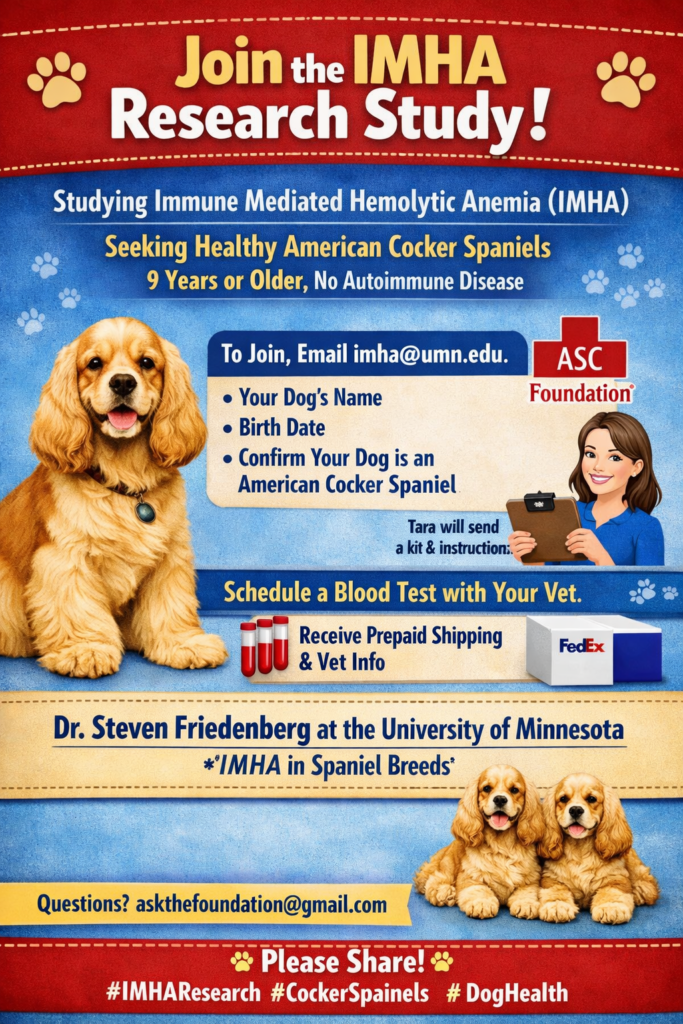
IMHA Seminar — University of Minnesota — Dr. Steven Friedenberg
The ASC Foundation is supporting a major research effort led by Dr. Friedenberg at the University of Minnesota. Click on this link to review a synopsis of the webinar on IMHA and the research Dr. Friedenberg is conducting, or read below for the full transcript. Due to a technical issue, there is no video recording.
Summary: click the link below
IMHA Seminar Summary
Transcript – Including Q&A at the End
This webinar featured Dr. Steven Friedenberg, who presented on immune-mediated hemolytic anemia (IMHA) in dogs, covering both the clinical aspects and ongoing research into the disease’s genetics and immunology. Dr. Friedenberg explained that IMHA is an autoimmune disorder in which the immune system mistakenly targets and destroys red blood cells, leading to anemia, and discussed how it particularly affects spaniel breeds, with Cocker Spaniels having a 12-fold increased risk compared to average dogs. He outlined five pillars of treatment: immunosuppression with drugs like prednisone, blood clot prevention, blood transfusions, treating underlying causes, and supportive care, noting that about two-thirds of dogs can have medications tapered while one-third require lifelong therapy. The presentation covered ongoing research to identify genetic risk factors in Cocker Spaniels, English Cocker Spaniels, and English Springer Spaniels through genome sequencing, as well as studies to identify the specific immune cells that trigger the disease. During the Q&A session, participants asked about environmental triggers, seasonal patterns, similarities to human IMHA, and treatment advances over the past 15 years; Dr. Friedenberg explained that while new treatments like Plavix and Eliquis have improved outcomes, the disease remains challenging because high mortality rates are driven primarily by blood clots.
- Interested participants with affected dogs: Contact Steven or Tara to coordinate sample collection (cheek swabs or blood samples) and shipping.
Immune-Mediated Hemolytic Anemia Presentation
Steven presented on immune-mediated hemolytic anemia (IMHA), explaining the disease’s components and its impact on red blood cells and the body. He described IMHA as an autoimmune condition that affects red blood cell function, leading to anemia, and noted its high morbidity and mortality rates, with approximately 50% of patients currently experiencing fatal outcomes. The presentation covered both the disease basics and ongoing research efforts to understand and treat IMHA.
IMHA Disease Explanation Meeting
Steven explained that IMHA is a complex genetic disease affecting dogs, particularly common in spaniel breeds like Cocker Spaniels. He explained that the disease occurs when antibodies coat red blood cells, causing splenic macrophages to destroy them. Steven distinguished between primary IMHA, which has no clear identifiable cause in 70-80% of cases, and secondary IMHA, which is triggered by factors such as cancer or infectious diseases.
Canine IMHA Genetic Risk Factors
Steven discussed the increased risk of Immune-Mediated Hemolytic Anemia (IMHA) in certain dog breeds, particularly Cocker Spaniels and Springer Spaniels, with a 10- to 12-fold higher risk than average dogs. He explained that while the average age of onset is middle age (5-6 years), the disease can occur in dogs as young as 9 months and as old as 12 years. Steven presented genetic evidence showing a strong connection among breeds in the “red area” of a genetic relatedness cladogram, including English Cocker Spaniels, Field Spaniels, American Cocker Spaniels, English Springer Spaniels, and Clumber Spaniels, all of which have a high prevalence of IMHA. He also described the clinical signs of the disease, including pale, yellow mucous membranes; weakness; lethargy; anorexia; vomiting; fever; fast heart and respiratory rates; and an enlarged liver and spleen, along with the diagnostic finding of anemia on blood work.
Immune-Mediated Hemolytic Anemia Treatment
Steven explained the clinical presentation and diagnostic findings of Immune-Mediated Hemolytic Anemia (IMHA) in dogs, including characteristic blood cell changes and evidence of autoimmunity visible under microscopy. He outlined five pillars of treatment:
- Immunosuppression: Often using prednisone with secondary medications like mycophenolate
- Prevention of blood clots: Using drugs like Plavix or enoxaparin
- Blood transfusions: When needed to stabilize the patient
- Treating underlying causes: Addressing any secondary triggers
- Supportive care: Managing symptoms and complications
Steven also mentioned a new therapy called plasmapheresis, which removes autoantibodies from the bloodstream, though it is currently available only at select locations.
IMHA Genetic Research Discussion
Steven discussed the treatment and prognosis of Immune-Mediated Hemolytic Anemia (IMHA) in dogs, noting that while therapy can be effective, it is expensive and may require lifelong treatment for some cases. He explained that about two-thirds of dogs can have medications tapered over time, while one-third require lifelong therapy. Steven outlined his ongoing research focused on understanding genetic risk factors and immunology behind IMHA in English and American Cocker Spaniels and English Springers, as well as building breed-specific reference genomes to better map genetic diseases in these breeds. Steven also described the process of identifying genetic markers associated with IMHA using DNA analysis, providing an example of how genetic variations can be linked to specific traits or conditions.
Cocker Spaniel IMHA Research Study
Steven explained his research on idiopathic immune-mediated hemolytic anemia (IMHA) in Cocker Spaniels, describing how they collect DNA from hundreds of dogs to identify genetic variants associated with the disease. He outlined two main study components:
- Genetics study: Focusing on both healthy and affected dogs, requiring cheek swabs or blood samples
- Immunology study: Seeking tissue from dogs nearing the end of their life for post-euthanasia collection to understand specific immune cells triggering the disease
Steven emphasized that while genetics will explain part of the predisposition, environmental factors likely play a role, and the goal is to develop risk prediction models rather than guaranteed disease outcomes.
Research Study Overview
|
Study Component
|
Primary Objective
|
Methods & Approach
|
Participation Requirements
|
|
Phase 1: Genetics Study
|
Identify genetic variants and risk factors associated with IMHA in Cocker Spaniels, English Cocker Spaniels, and English Springer Spaniels
|
· Collect DNA from hundreds of dogs (both healthy and affected)
· Perform genome sequencing
· Build breed-specific reference genomes
· Map genetic markers associated with IMHA
|
· Collect cheek swabs or blood samples from affected dogs
· Collect samples from healthy control dogs
· Coordinate with Steven or Tara for sample collection and shipping
|
|
Phase 2: Immunology Study
|
Understand which specific immune cells trigger IMHA and how the autoimmune response develops
|
· Collect tissue samples from dogs nearing end of life
· Analyze immune cell populations
· Study autoantibody production mechanisms
|
· Post-euthanasia tissue collection from affected dogs
· Contact research team in advance to coordinate timing
|
|
Phase 3: Risk Prediction Models
|
Develop predictive tools to assess individual dog risk based on genetic and environmental factors
|
· Integrate genetic data with clinical outcomes
· Account for environmental factors
· Create breed-specific risk assessment tools
|
· Long-term follow-up data from participants
· Ongoing collaboration with breeders and owners
|
|
Supporting Initiative: Blood Drive
|
Build reference database from healthy older dogs to support comparative studies
|
· Collect 3 mLs of blood from healthy dogs 9+ years old
· Establish baseline genetic and immunological profiles
|
· Healthy dogs aged 9 years or older
· Contact ASC Foundation to participate
|
How to Participate in Research
Email: IMHA@umn.edu
Website: freedlab.org/participate
Blood Drive (healthy dogs 9+ years): Contact ASC Foundation to donate 3 mLs of blood
Sample Collection (affected dogs): Contact Steven or Tara to coordinate cheek swabs or blood samples and shipping arrangements
Canine Immune-Mediated Hemolytic Anemia
Steven discussed immune-mediated hemolytic anemia (IMHA) in dogs, explaining that no evidence links the disease to environmental toxins, pesticides, or medications. He noted that while spaying/neutering increases the risk of Addison’s disease in poodles and Portuguese water dogs, it may not increase the risk of IMHA. Steven explained that most IMHA cases occur without identifiable triggers. When triggers are suspected, diagnostic tests like chest X-rays and ultrasounds are used to look for cancer or tick-borne diseases. He also discussed differences between canine and human IMHA, noting that dogs experience more severe inflammatory responses and blood clots than humans, and that newer treatments like anti-clotting medications (Plavix, Eliquis) and immunosuppressive drugs have improved outcomes over the past 15 years. However, the disease remains challenging due to high mortality rates primarily from blood clots.
FAQ: IMHA Seminar Q&A with Dr. Steven Friedenberg
Scope note: The meeting record indicates that no transcript is available, so this FAQ is a structured, paraphrased document based on the available meeting summary and Zoom Doc—not verbatim participant questions or answers. [2]
- Are environmental toxins, pesticides, or medications known to trigger IMHA?
Dr. Friedenberg explained that no evidence links canine IMHA to environmental toxins, pesticides, or medications. Most IMHA cases occur without an identifiable trigger; when veterinarians suspect a secondary trigger, they may investigate possible causes such as cancer or tick-borne disease using diagnostics like chest X-rays and ultrasounds. [2]
- Is there a seasonal pattern to IMHA?
Participants asked about seasonal patterns, but the available meeting materials do not preserve a specific answer confirming or rejecting seasonality. The clearest related point is that environmental factors may contribute to overall risk. Still, Dr. Friedenberg emphasized that current research aims to develop risk prediction models, not to guarantee whether an individual dog will develop IMHA. [2]
- How does canine IMHA compare with IMHA in humans?
Dr. Friedenberg noted that dogs tend to experience more severe inflammatory responses and blood clots than humans with IMHA. This makes canine IMHA especially challenging, because blood clots remain a major driver of poor outcomes. [2]
- Have treatments improved over the past 15 years?
Yes. Dr. Friedenberg explained that newer anti-clotting medications, including Plavix and Eliquis, along with immunosuppressive drugs, have improved outcomes over the past 15 years. However, IMHA remains a serious disease with high mortality, primarily because of blood clot complications. [2]
- What are the main treatment approaches for IMHA?
Dr. Friedenberg described five major treatment pillars for canine IMHA: [2]
- Immunosuppression, often using prednisone and sometimes secondary medications such as mycophenolate.
- Preventing blood clots with medications such as Plavix or enoxaparin.
- Blood transfusions, when needed to stabilize the patient.
- Treatment of underlying causes, if a secondary trigger is identified.
- Supportive care to manage symptoms and complications.
Dr. Friedenberg also mentioned plasmapheresis, a newer therapy that removes autoantibodies from the bloodstream, though availability is limited to select locations. [2]
- Can dogs recover enough to stop medication?
Dr. Friedenberg explained that treatment can be effective, but some dogs require long-term therapy. About two-thirds of dogs can eventually taper off medication, while about one-third require lifelong treatment. [2]
- Is IMHA mainly genetic?
Dr. Friedenberg described IMHA as a complex disease with an important genetic component, especially in spaniel breeds. The research goal is to identify genetic risk factors and build better risk prediction models, while recognizing that environmental factors may also influence whether disease develops. [2]
- Which breeds are at higher risk?
Dr. Friedenberg stated that IMHA is particularly common in spaniel breeds, with Cocker Spaniels and Springer Spaniels having about a 10–12-fold higher risk than average dogs. The meeting materials also identify English Cocker Spaniels, Field Spaniels, American Cocker Spaniels, English Springer Spaniels, and Clumber Spaniels as breeds in a genetically related group with high IMHA prevalence. [2]
- What symptoms should owners and veterinarians watch for?
Dr. Friedenberg described clinical signs that can include pale or yellow mucous membranes, weakness, lethargy, anorexia, vomiting, fever, fast heart and respiratory rates, and enlarged liver and spleen. Blood work commonly shows anemia, and microscopy may show changes consistent with immune-mediated red blood cell destruction. [2]
- What research is Dr. Friedenberg conducting?
Dr. Friedenberg’s research focuses on identifying genetic variants associated with IMHA in Cocker Spaniels, English Cocker Spaniels, and English Springer Spaniels, as well as studying immune cells involved in the disease. The work includes DNA collection from healthy and affected dogs, genome sequencing, breed-specific reference genomes, and an immunology study involving tissue collection from affected dogs near the end of life. [2]